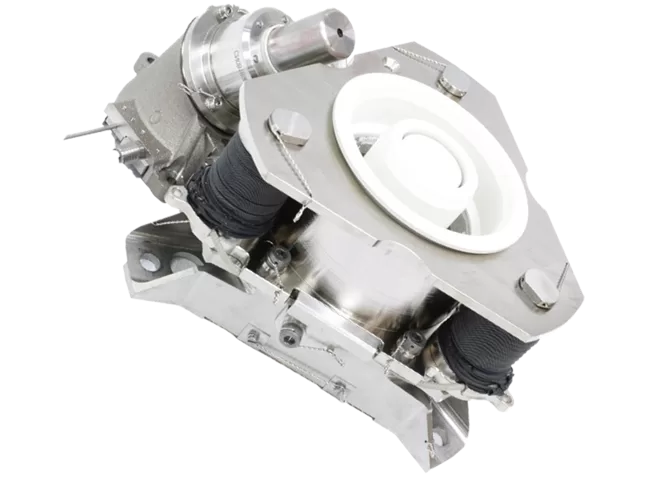
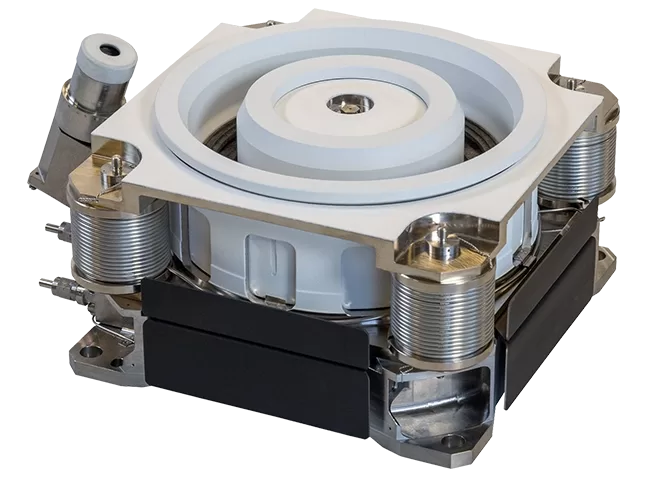
EPS®1350
Electric Propulsion System
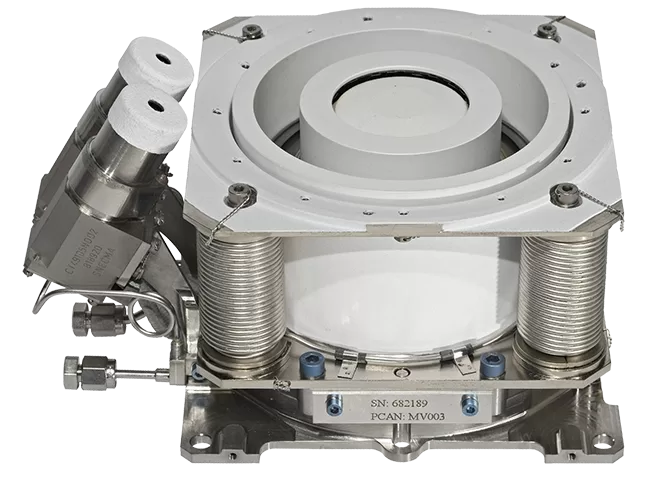
The EPS®1350 satellite propulsion system draws on Safran’s long experience with electric propulsion. It is designed for orbital transfer, station keeping and deorbiting satellites and other spacecraft. In particular, the EPS®1350 was the primary engine on ESA’s lunar probe, Smart-1, launched in 2003 by an Ariane 5 rocket. This mission was completed in September 2006.
MAIN ADVANTAGES
DESIGNED FOR ORBIT-TOPPING AND STATION-KEEPING
40% WEIGHT SAVING CONVENTION PROPULSION
EXCELLENT THRUST-TO-ELECTRICAL POWER RATIO
Very High Performance
The major advantage of the EPS®1350 is of course its very high specific impulse, which allows significant weight savings versus platforms using conventional chemical propulsion. It also offers an excellent thrust-to-electrical power ratio, which enables reducing operating time or the number of thrusters needed.
In-Orbit Experience
The EPS®1350 amply demonstrated its capabilities during ESA’s Smart-1 probe’s mission from Earth orbit into orbit around the Moon: 5,000 hours cumulated operating time in space Four of these thrusters handle North/South station-keeping duties on the Alphasat satellite, launched in 2013. The EPS®1350 was selected by Space Systems Loral in 2016 and will be used on the company’s communications satellites for station-keeping, and for part of the orbit-topping operation.